

Does scheduling sex work?
Updated 22 November 2026, by Crack'd Health
In the one randomized test, yes. Parents nudged to plan sex reported about 28% more in two weeks (Kovacevic et al. 2025, randomized, 514 parents of young children).
Planned sex was not rated less satisfying than spontaneous sex in the same lab's diary study of more than 100 couples (York University, 2023).
The catch: 33% of people in one survey said scheduling intimacy had added pressure (Tawkify, 2026). A plan helps when either of you can say no to it.
What the experiment did
Researchers at York University recruited parents whose youngest child was five or under, in Canada, the US, the UK, Australia and New Zealand (York University, 1 Dec 2025). One group read a research summary on the value of planned sex and was encouraged to plan sex with their partner over the next two weeks. The other group read that researchers were unsure whether planned or spontaneous sex is more satisfying, and was asked to carry on as usual.
Two weeks later, the planning group reported more planned sex, more sex overall and more desire. Among people who had sex at least once in those two weeks, the planning group also felt less obligated to have it. Amy Muise, one of the authors, put the difference at "at least one more sexual experience a month for a couple" (York University).
What it does not show, said plainly:
- It ran for two weeks, and the counts are what people reported.
- Everyone in it was a parent of a young child. People without kids may respond differently.
- It changed what people believed about planning and suggested a conversation. It did not test a calendar or an app. Crack'd itself has not been tested.
Who already plans it
Scheduling sex, partnered US adults
Share who said each, March 2026
Planning is already common. In the same survey, the top reasons were to make sure it happens (57%) and to build anticipation (39%). Two in three (67%) had never used a dedicated tool for it, and 20% used Google or Apple Calendar (Tawkify).
Is planned sex worse sex?
The idea that spontaneous is better is common; the evidence for it is thin. In a survey of more than 300 people, believing spontaneous sex is better went with higher satisfaction. But in a three-week daily diary of more than 100 couples, whether the most recent time was planned or spontaneous made no difference to how satisfying it was (York University, 2023). In Tawkify's survey, 52% said planned time feels as satisfying as spontaneous, and 6% called it forced (Tawkify).
How often is enough?
More is not the goal past a point. In three studies, well-being rose with frequency up to about once a week and then leveled off (Muise, Schimmack and Impett, 2016). The backdrop: adults 18 to 64 reporting sex weekly or more fell from 55% in 1990 to 37% in 2024 in the General Social Survey, a survey (Institute for Family Studies). Crack'd has a weekly target only if you set one; it starts off.
Planning it so it helps
- Make it a conversation, not a notice. The York team stressed to the planning group that planning sex "needs to be a conversation with your partner" (Kovacevic, York University).
- Pick a time with energy left. Muise's own advice for a planned night is to have it before the big meal and the wine, not after (York University, 2023).
- Plan the time, not the outcome. A plan is a window to be together. What happens in it is up to the two of you on the night.
- Keep no easy. A plan that one of you can't turn down becomes a chore. More on that in asking and saying no.
- Keep the calendar discreet. Whatever title you choose is what anyone who can see your calendar will see.
How Crack'd plans a night
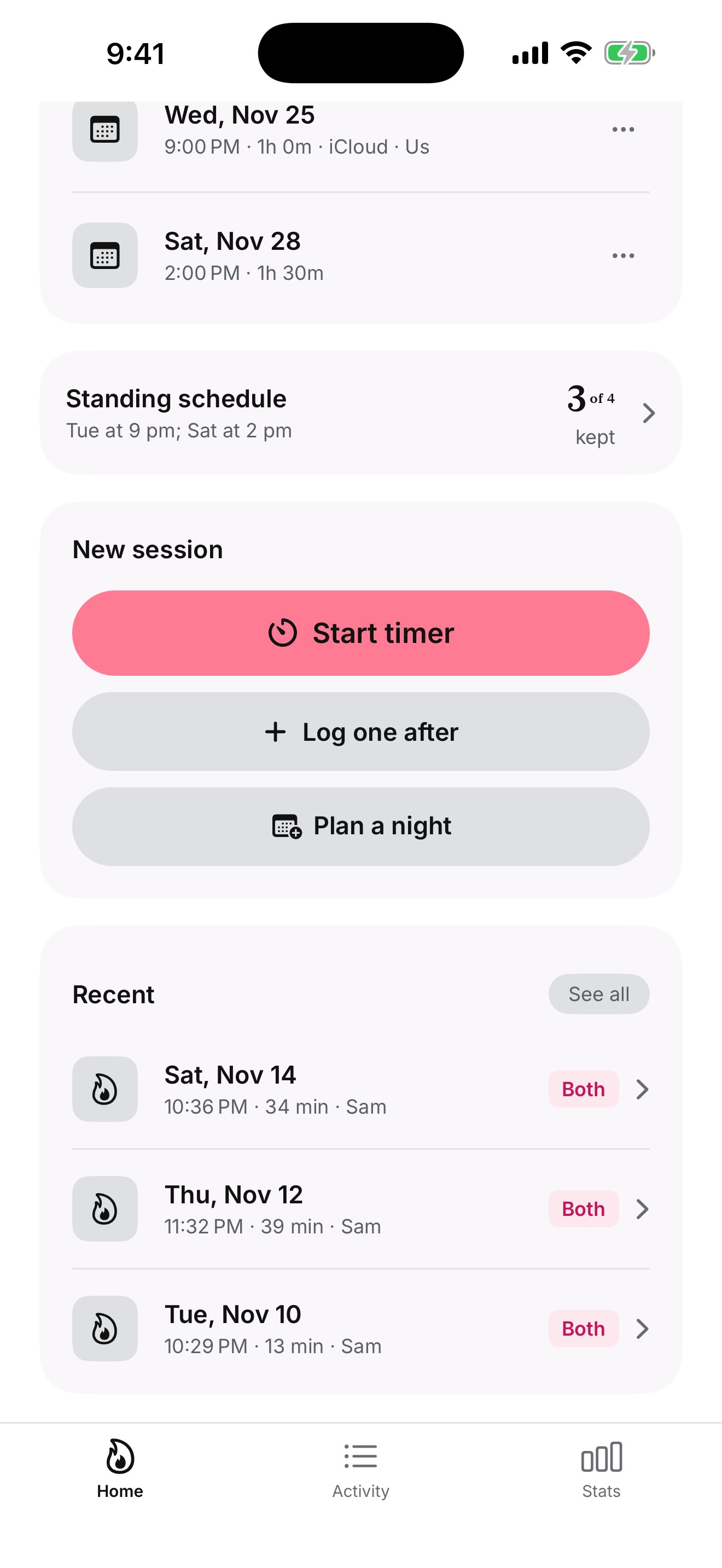
You pick when, how long and which calendar. With your partner in the app, the plan goes to them as a request, and they answer from the notification: yes, a new time, or no. A yes puts it on the schedule, and on both calendars if you have both allowed calendar access, with a reminder an hour before if you leave that on. A standing schedule repeats the nights you choose every week. The calendar event carries only the title you set; nothing from your log goes into it.
Planning, requests and the standing schedule are part of Crack'd Plus. Logging is free. No account, no Crack'd server. Your log stays on your phone; a shared log uses your own iCloud.

Sources
- Kovacevic, Smith, Fitzpatrick, Rosen, Huber and Muise, The Journal of Sex Research, 2025: doi.org/10.1080/00224499.2025.2585377. Randomized, 514 parents of young children.
- York University news release, 1 Dec 2025: Priming for planned sex increases desire, frequency in parents with young children.
- York University news release, 13 Feb 2023: Is spontaneous sex better?
- Tawkify, March 2026, 911 partnered US adults, online: Scheduling intimacy.
- Muise, Schimmack and Impett, Social Psychological and Personality Science, 2016: Sexual frequency predicts greater well-being, but more is not always better.
- General Social Survey, analysis by the Institute for Family Studies, Aug 2025: The sex recession.
For adults 18 and over. Crack'd Health is made by Amblee LLC. Screens show example data, not a real person's log. This page is information, not medical advice.