

How do you ask for sex, and how do you say no kindly?
Updated 22 November 2026, by Crack'd Health
Ask for a specific time, as a question you can hear no to. If the answer is no, meet it with warmth, not a sulk.
Say no warmly, with a rain check if you mean one. In three studies, warm rejections that showed interest in sex at a future time kept the asker's interest up; hostile or critical ones bred resentment (Dobson et al. 2025).
A kind no does not seem to cost the relationship: in a four-week diary of 98 couples, a reassuring rejection did not appear to lower overall relationship satisfaction (Kim, Muise and Impett 2018).
Why a no has to be safe
Writing for the Gottman Institute, couples therapist and certified sex therapist Kyle Benson sums up John Gottman's research this way: "it has to be okay, even rewarding, for either partner to refuse sex." The same piece says that meeting a no with a positive response leads to more sex, not less, and that a request turns into a demand when the person asking criticizes or withdraws after hearing no (Gottman Institute).
The research agrees. In two surveys of 642 adults, people said they would rather a partner turn them down kindly than say yes reluctantly to avoid a fight. In the follow-up diary of 98 couples, a reassuring no did not appear to hurt overall relationship satisfaction (Kim, Muise and Impett 2018, via PsyPost). The honest catch from the same study: on the day itself, having sex to avoid conflict went with higher sexual satisfaction than a kind no. A no can cost the night. It doesn't seem to cost the couple.
Planning raises the stakes
How scheduling feels, partnered US adults
Share who said each, March 2026
Most people like having time set aside, and a third say it has added pressure. A plan makes the ask more concrete, which makes a no feel bigger. That is why the planning experiment Crack'd cites told people that planning sex "needs to be a conversation with your partner", and why, among those who had sex, the planning group felt less obligated, not more (York University, 1 Dec 2025). More on that experiment in does scheduling sex work?
Asking well
- Ask for a time. A night, a time, how long. "Thursday at nine?" is easier to answer than a hint.
- Ask as a question. If you would sulk at a no, you are not ready to ask yet.
- Talk first, then plan. Agree on what planning is for before anything goes on a calendar.
- Agree on a signal. Gottman's examples of rituals for asking and declining include a couple who moved a pair of dolls on their mantle, and a back rub that leaves room to stop (Gottman Institute).
- Ask what makes no easy. The same piece suggests asking your partner what they need from you to feel comfortable saying no.
Saying no well
- Say it warmly. Make clear it is about tonight, not about them.
- Offer a rain check only if you mean it. "Not tonight. Saturday?" is the kind of no that kept interest up in the Dobson studies.
- A reason is optional. No is a full answer.
- If you are the one who hears no: thank them for saying so, and let it go. That is the response Gottman ties to more sex over time.
When no is the usual answer
Different levels of desire are common in long relationships; one study of women in long-term relationships with men framed the gap as a normal part of them, not a fault, and found scheduling among the ways women got back in sync (Herbenick, Mullinax and Mark 2014). If it weighs on either of you, a certified sex therapist can help; AASECT lists them. An app is not a substitute.
How answers work in Crack'd
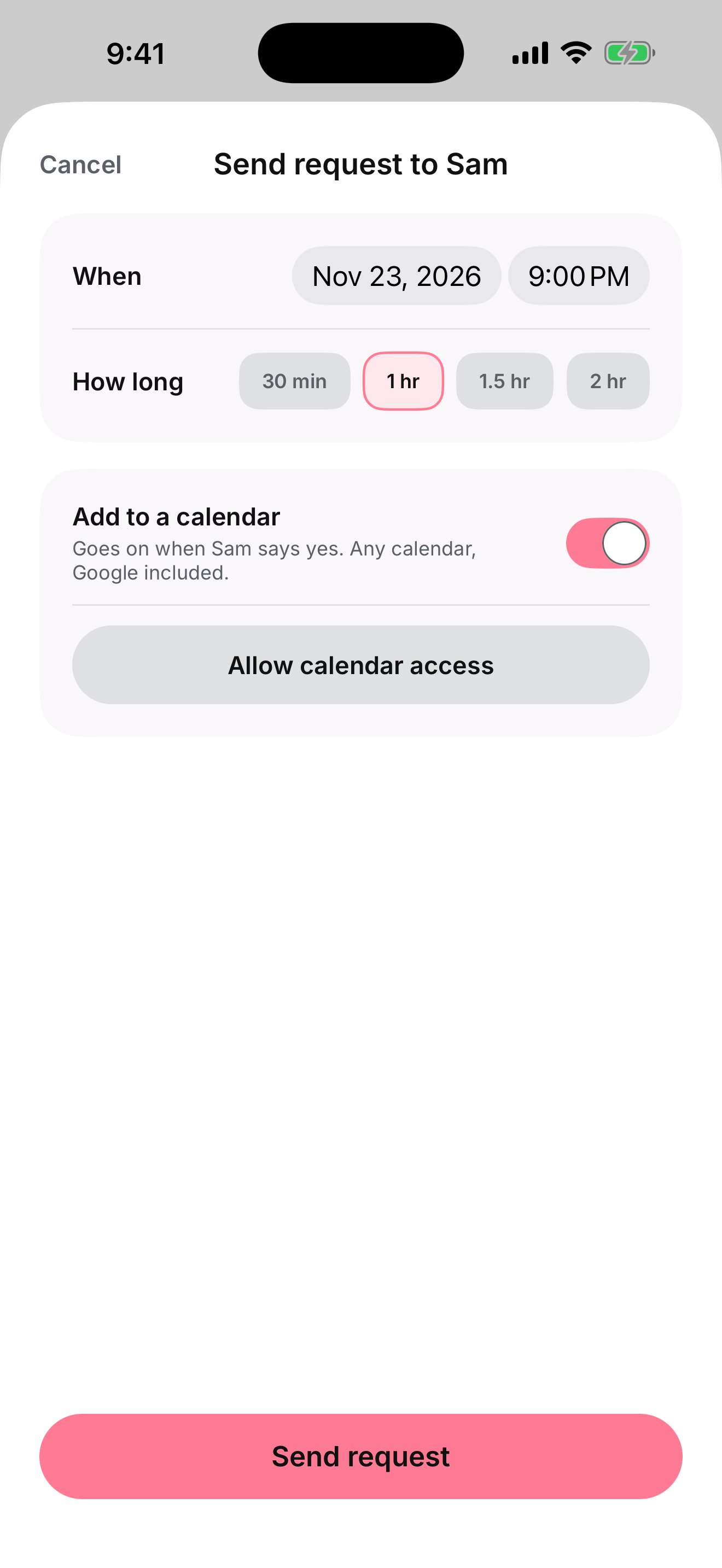
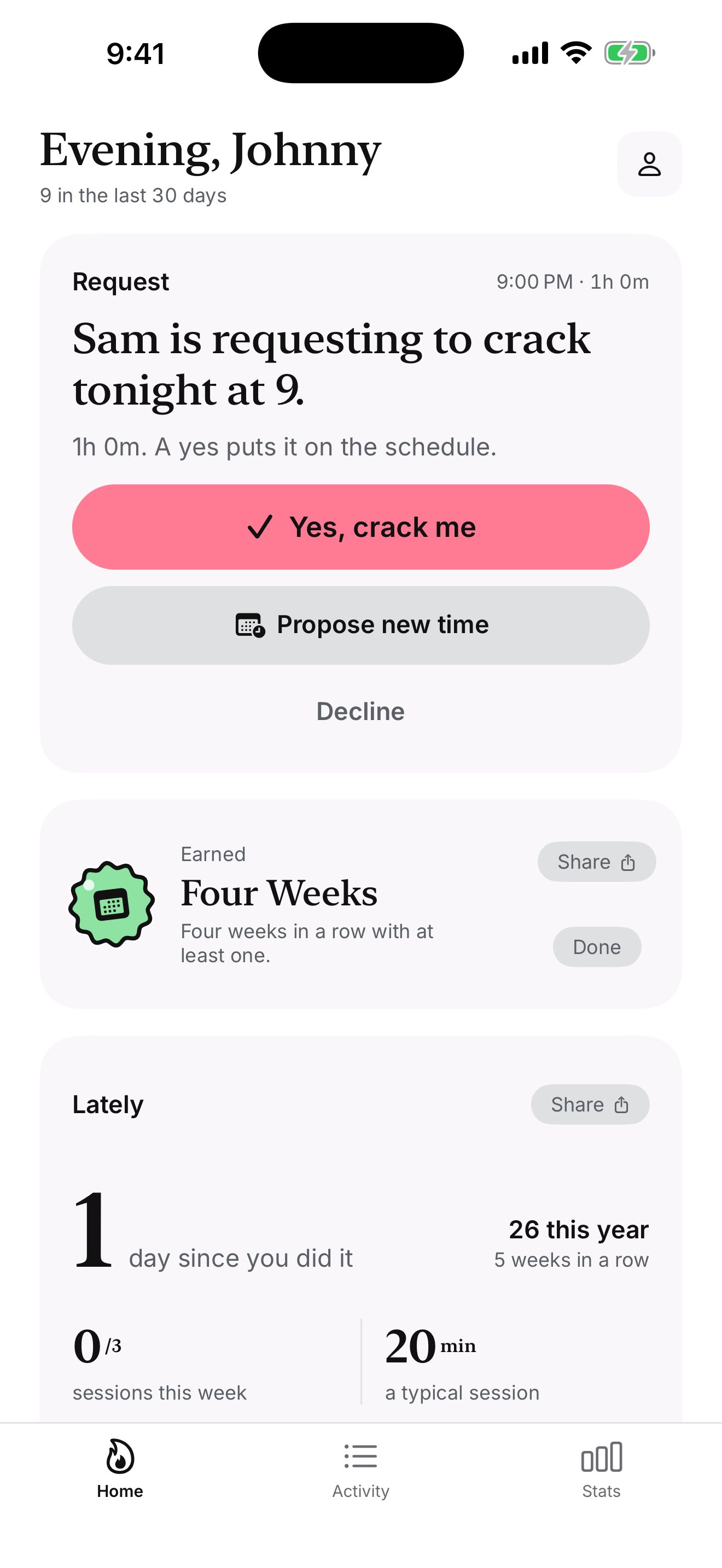
When you ask in Crack'd, you pick a night, how long and a calendar. Your partner gets one notification and can answer from it without opening the app: yes, a new time, or no. A yes puts it on the schedule, and on both calendars if you have both allowed calendar access. A new time sends a different night back to you. A no is one tap; you get one line saying so, with the option to suggest another night. The calendar event carries only the title you set.
Requests and the shared log are part of Crack'd Plus; Family Sharing is on, so one purchase covers your partner. No account, no Crack'd server. Your log stays on your phone; a shared log uses your own iCloud.
Sources
- Kyle Benson for the Gottman Institute: 5 simple ways to make sex more romantic.
- Dobson, Kim, Muise, Harasymchuk and Impett, The Journal of Sex Research, 2025, three studies, summarized by McMaster University: Communicating sexual rejection in romantic relationships.
- Kim, Muise and Impett, Journal of Social and Personal Relationships, 2018, via PsyPost, 15 Apr 2018: Rejecting a partner kindly versus having sex reluctantly.
- Tawkify, March 2026, 911 partnered US adults, online: Scheduling intimacy.
- York University news release, 1 Dec 2025, on Kovacevic et al. 2025 (doi.org/10.1080/00224499.2025.2585377): Priming for planned sex.
- Herbenick, Mullinax and Mark, The Journal of Sexual Medicine, 2014: PubMed 25052706.
- AASECT: referral directory of certified sex therapists.
For adults 18 and over. Crack'd Health is made by Amblee LLC. Screens show example data, not a real person's log. This page is information, not medical or therapeutic advice.